
The vocational rehabilitation (VR) landscape is undergoing a seismic shift. As we navigate 2026, the question is no longer if you use Artificial Intelligence, but how effectively you are leveraging it. At Vocational Quest, we champion the "Work Smarter" pillar: using technology not as a crutch, but as a catalyst for deeper human connection and more defensible outcomes.
However, many practitioners are stumbling into the "uncanny valley" of AI integration. They are either over-relying on the tech or avoiding it out of a misplaced sense of professional purity. According to Statistics Canada, while nearly 1 in 7 Canadian businesses have already integrated generative AI into their workflows, the professional services sector: including counseling and rehab: often struggles with the "implementation gap."
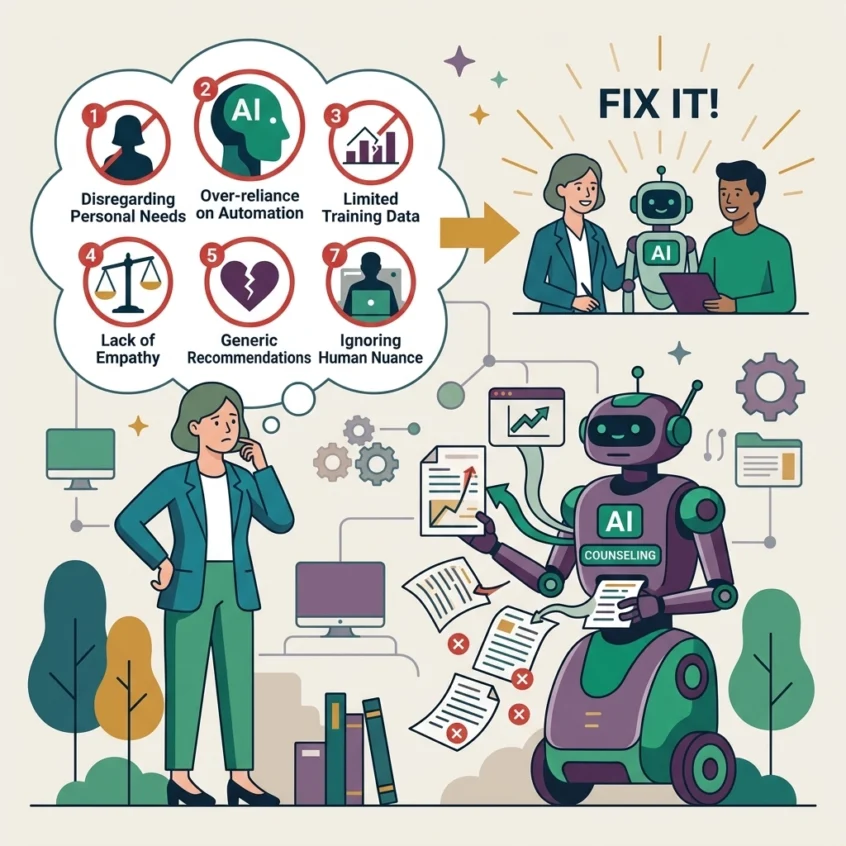
If you want to lead fearlessly in this new era, you need to stop making these seven common mistakes.
1. The "Auto-Pilot" Trap: Treating AI as a Final Decision Maker
The most dangerous mistake is treating an LLM (Large Language Model) output as a finished product. AI is a brilliant "first-draft" engine, but it lacks the nuance of lived experience. In vocational counseling, professional judgment is your most valuable asset. When you let an algorithm decide a client's "suitable employment" without rigorous human oversight, you aren't just being lazy: you're being negligent.
The Fix: The "Human-in-the-Loop" Framework
Always treat AI outputs as suggestions, not mandates. Use AI to generate a list of 15 potential job matches based on a Transferable Skills Analysis (TSA), then use your clinical expertise to whittle that list down to the three most viable options. Your role is to validate the logic, not just copy-paste the results.

2. Privacy Neglect: Feeding the "Public" Beast
Many counselors are inadvertently breaching confidentiality by inputting sensitive client data into public-facing AI tools. If you are typing a client’s full medical history or specific vocational barriers into a free version of a popular chatbot, that data is often used to train future models. In the Canadian context, this could lead to significant PIPEDA (Personal Information Protection and Electronic Documents Act) violations.
The Fix: Data Anonymization and Enterprise Guardrails
Never use personally identifiable information (PII). Instead of "John Doe, a 45-year-old welder from Sudbury with a L4-L5 disc herniation," use "A 45-year-old skilled tradesperson with a lumbar spine impairment." Better yet, utilize enterprise-grade AI solutions that offer data privacy guarantees, ensuring your inputs remain within your organization’s "walled garden."
3. Prompting Like a Search Engine
Most VR professionals use AI like it’s Google. They ask short, vague questions like, "What jobs can a person with a back injury do?" and then get frustrated when the answer is generic and unhelpful. AI doesn't need keywords; it needs context, persona, and constraints.
The Fix: Master Contextual Engineering
Stop searching and start "engineering." Use the "Act as" framework.
Example: "Act as a Senior Vocational Rehabilitation Consultant in Ontario. Review these functional limitations and suggest five sedentary occupations that align with the National Occupational Classification (NOC) 2021 codes, focusing on the Toronto labor market trends for 2026."
By providing a role, a location, and a specific classification system, you force the AI to work within professional parameters.
4. Ignoring the "Intuition Gap" (Non-Verbal Cues)
AI is excellent at processing text, but it is "blind" to the room. It cannot see the way a client’s shoulders slump when a certain industry is mentioned. It cannot hear the hesitation in their voice when discussing their return-to-work fears. A mistake many are making is prioritizing AI-generated "data points" over the intuitive cues gathered during an interview.
The Fix: Multi-Modal Observation
Use AI for the heavy lifting of data synthesis: summarizing meeting notes or analyzing job descriptions: but keep the actual counseling session a "Human-First" zone. Use your intuition to challenge the AI's suggestions. If the AI suggests a high-stress administrative role but your intuition tells you the client’s anxiety will spike in that environment, the intuition wins every time.

5. The Bias Blind Spot: Assuming the Machine is Objective
AI models are trained on historical data, and historical data is often biased. If a model suggests that "leadership roles" aren't a fit for a specific demographic, it might be reflecting societal biases rather than the client’s actual potential. Relying on AI without checking for these biases can lead to "pigeonholing" clients into low-growth sectors.
The Fix: The Diversity and Inclusion Audit
Proactively challenge the AI. Ask it, "What are the potential biases in the recommendations provided?" or "Show me high-growth opportunities for this client that might be overlooked by traditional career assessments." Use technology to expand a client’s horizon, not to mirror the limitations of the past.
6. Gatekeeping Technology from Your Clients
There is a tendency to want to hide the "magic" from clients, fearing they might realize they can do the work themselves. This is a mistake. In the 2026 job market, AI literacy is a core employability skill. If you aren't teaching your clients how to use AI to optimize their resumes or practice for interviews, you are doing them a disservice.
The Fix: Collaborative AI Literacy
Bring the client into the process. Show them how you are using AI to research labor markets. Help them use AI tools to bridge their own skill gaps. This builds trust and empowers the client to navigate the digital-first job market long after their file is closed.
To see how we integrate these concepts into professional development, check out our leadership and AI-driven vocational training modules.
7. Stagnant Workflows: Failing to Iterate
The AI you used six months ago is already obsolete. A common mistake is finding one prompt or one tool that works and sticking with it forever. In a field that is increasingly defined by rapid change, a "set it and forget it" mentality will lead to professional stagnation.
The Fix: The Weekly Friction Audit
Spend 15 minutes every Friday identifying the most repetitive, "un-human" task you did that week. Research how AI might streamline it. Whether it's drafting initial assessment reports or conducting labor market research, aim to automate the friction so you can focus on the transformation.

The Intuitive Shift: Why This Matters Now
In Canada, the Labour Market Information (LMI) Council has highlighted that the "skills gap" is widening in sectors impacted by automation. As vocational professionals, our job is to be the bridge. We cannot build that bridge if we are afraid of the tools or if we use them incorrectly.
The shift we need is moving from "Counselor as Information Provider" to "Counselor as Strategic Architect."
When you stop making these seven mistakes, you free up the mental bandwidth required to actually listen to your clients. You move from the teal pillar of Work Smarter into the blue pillar of Leading Fearlessly. You become the practitioner who doesn't just manage a caseload, but masters the technology to provide radically better outcomes.
The Takeaway
AI in vocational counseling is not a threat; it’s a force multiplier. But it requires a pilot who is awake at the wheel. Correct these mistakes, refine your prompts, and never: ever: compromise on the human intuition that brought you into this field in the first place.
If you’re ready to stop guessing and start mastering the digital vocational landscape, I break this down further inside The Intuitive Workplace Pro.
Work Smarter. Lead Fearlessly. Stay Human.