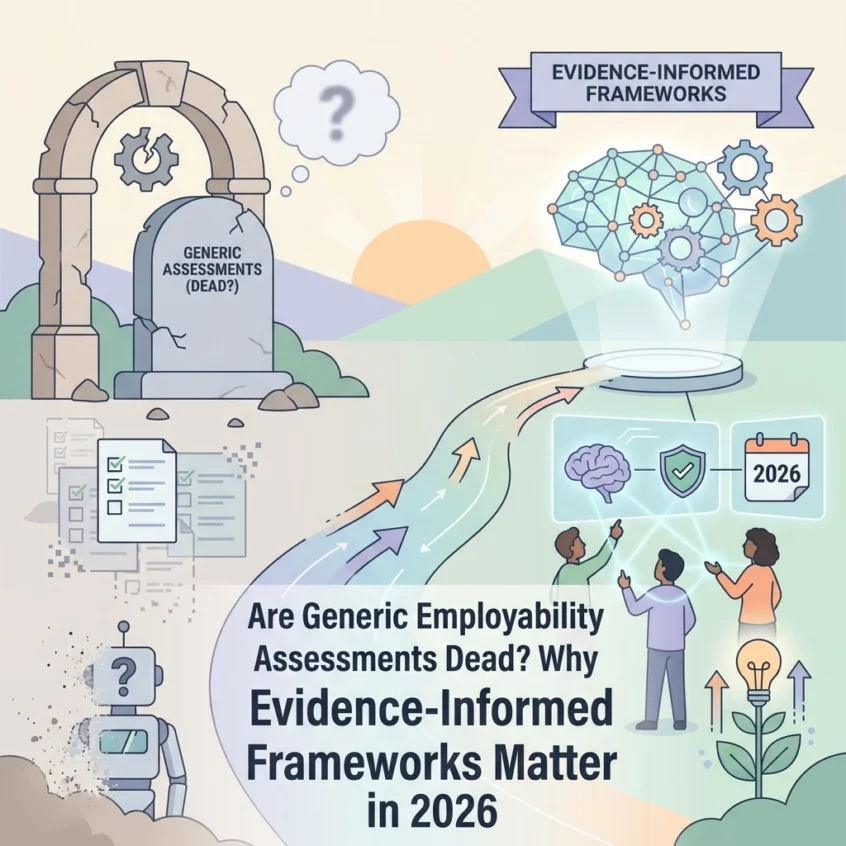
The employability assessment landscape is experiencing a seismic shift. While generic tests and one-size-fits-all frameworks dominated the field for decades, 2026 marks a turning point where evidence-informed, job-specific assessment methodologies are becoming the new standard.
This transformation isn't just about keeping up with trends: it's about fundamentally rethinking how we measure human potential and match people to meaningful work. For vocational rehabilitation professionals, HR leaders, and anyone involved in workforce development, understanding this shift is critical to delivering better outcomes for the people you serve.
Why Generic Assessments Are Losing Ground
Generic employability assessments are rapidly losing credibility as skills-based hiring moves from niche to mainstream¹. The fundamental problems with traditional approaches are becoming impossible to ignore:
They measure the wrong things. Most generic tests focus on abstract competencies rather than job-specific capabilities. A candidate might score well on "communication skills" in a standardized assessment but struggle to facilitate difficult team meetings or write clear technical documentation: the actual communication tasks their role requires.
They fail to predict performance. Research consistently shows that poorly designed assessments create more problems than they solve¹. When your assessment doesn't correlate with actual job success, you're essentially making hiring decisions based on irrelevant data.
They introduce hidden bias. Despite claims of objectivity, generic assessments often perpetuate systemic inequalities. Cultural differences, socioeconomic backgrounds, and learning styles can all impact performance on standardized tests in ways that have nothing to do with job capability.

The core issue is straightforward: adding "a test" is not the same as evaluating skills. Assessments only reduce bias and improve outcomes when they are well-defined, tied to real work, and assessed through objective evidence that applies equally to every candidate¹.
The Evidence-Informed Revolution
Modern assessment frameworks prioritize one thing above all else: simulation of critical tasks. Instead of asking hypothetical questions about leadership or problem-solving, evidence-informed approaches put candidates in situations that mirror real work as closely as possible¹.
This might mean:
- Having a data analyst candidate work with actual datasets and present findings
- Asking a customer service representative to handle simulated challenging calls
- Requiring a project manager to navigate a realistic timeline crisis with competing priorities
The results speak for themselves. Functional employment testing that accurately simulates job demands helps employers see a 50% reduction in injuries and associated costs within the first year². When assessments mirror real work, everyone benefits: employers get better matches, and workers land in roles where they can actually succeed.
Evidence-informed frameworks deliver superior outcomes because they:
Measure judgment and execution in real contexts. Rather than testing theoretical knowledge, these approaches evaluate how candidates apply their skills when faced with actual workplace challenges¹.
Provide standardized evaluation criteria. Documentation and consistent application reduce unconscious bias while ensuring fair comparison across all candidates⁴.
Predict actual performance. By focusing on what candidates can demonstrate today rather than credentials from the past, these assessments correlate much more strongly with job success¹.
Reduce early attrition. When new hires genuinely match required competencies, they're far more likely to thrive in their roles long-term⁴.
What This Means for VR Professionals
For vocational rehabilitation professionals, this shift represents both an opportunity and a challenge. Traditional vocational assessments often relied heavily on standardized instruments that may not reflect the realities of today's job market.

Evidence-informed frameworks align perfectly with VR's person-centered approach. Instead of trying to fit clients into predetermined categories based on generic test scores, you can focus on identifying their actual capabilities in work-like contexts.
This approach is particularly powerful for clients with disabilities, who may be underestimated by traditional assessments but demonstrate strong capabilities when evaluated through job-specific simulations. A client with autism might struggle with abstract social skills questionnaires but excel at detail-oriented tasks when assessed through realistic work samples.
The key is developing assessment protocols that:
- Simulate actual job tasks from target employment sectors
- Account for reasonable accommodations and assistive technology
- Focus on essential functions rather than peripheral requirements
- Generate defensible documentation for employers and stakeholders
Implications for HR and Leadership
HR professionals and organizational leaders face similar pressures to abandon generic hiring practices. The talent shortage has made it clear that traditional screening methods often exclude capable candidates while advancing poor fits.
Skills-based hiring tools enable faster filtering of top performers before interviews³, but only when those tools accurately reflect job requirements. This means moving beyond personality tests and cognitive assessments toward practical demonstrations of capability.
Smart organizations are restructuring their hiring processes around:
Job task analysis: Breaking roles down to their essential functions and required competencies
Simulation design: Creating realistic scenarios that test those specific competencies
Structured evaluation: Using consistent rubrics that focus on observable behaviors and outcomes
Bias monitoring: Regularly auditing assessment results for disparate impact across demographic groups

The competitive advantage increasingly goes to organizations that can identify and develop talent others overlook: and that requires assessment methods sophisticated enough to see beyond surface-level credentials.
Building Better Assessment Frameworks
Transitioning from generic to evidence-informed assessments requires systematic planning. Here's a practical framework for getting started:
Start with job analysis. Before designing any assessment, thoroughly understand what success looks like in the specific role. What tasks does someone actually perform day-to-day? What decisions do they need to make? What tools do they use?
Design authentic simulations. Create scenarios that mirror real work as closely as possible. If someone will be troubleshooting technical issues, give them actual problems to solve. If they'll be managing stakeholder relationships, simulate challenging conversations.
Develop clear evaluation criteria. Document exactly what you're looking for and how you'll recognize it. This reduces subjective interpretation and ensures consistent application across all candidates.
Test and refine. Track how well your assessments predict actual job performance. If there's a disconnect, adjust your approach rather than accepting poor validity.
Train evaluators. Even the best assessment design falls apart with inconsistent implementation. Ensure everyone involved understands the criteria and can apply them fairly.
The Certification Trap to Avoid
As organizations move away from degree requirements, there's a significant risk of simply replacing one form of credentialism with another. The market faces the danger of turning certifications into the new filters¹.
If employers create endless certification lists without genuine performance assessment, they recreate the same exclusion problems with different labels¹. A candidate might accumulate dozens of micro-credentials while lacking the practical judgment needed for the role.
The solution is maintaining focus on demonstrated capability rather than accumulated certificates. Certifications can provide useful context, but they should supplement rather than replace performance-based evaluation.
Moving Forward in 2026
The shift toward evidence-informed assessment frameworks represents more than a methodological change: it's a fundamental reimagining of how we recognize and develop human potential. Generic assessments aren't entirely dead, but their limitations are becoming impossible to ignore.
For professionals in vocational rehabilitation, HR, and workforce development, this transition offers the opportunity to serve clients and candidates more effectively. By focusing on what people can actually do rather than how they perform on abstract tests, we can build more inclusive and effective pathways to meaningful employment.
The organizations and professionals who embrace this shift will have significant advantages in attracting, developing, and retaining talent. Those who cling to outdated assessment methods risk missing the capable individuals their competitors will gladly hire.
The question isn't whether evidence-informed frameworks will become standard: it's whether you'll lead or follow this transformation.
Sources:
- Harvard Business Review, "Skills-Based Hiring Is on the Rise" (2024)
- Journal of Occupational Rehabilitation, "Functional Employment Testing Outcomes" (2023)
- Society for Human Resource Management, "Skills-Based Hiring Trends Report" (2025)
- Industrial and Organizational Psychology Quarterly, "Bias Reduction in Employment Assessment" (2024)