
Most Canadian professionals are currently operating at about 60% capacity. It isn't because they’re lazy. It isn't because they lack the skill. It’s because they are drowning in administrative sludge.
If you look at the average work week in Canada, a staggering amount of time is spent on what we call "the boring." This isn't just a nuisance; it’s a productivity killer and a mental health hazard. According to research on workplace boredom, employees report being bored for roughly 10 hours every single week. That’s more than a full day of labour lost to the void.
At Vocational Quest, we believe the future of work isn't about humans doing more. It’s about humans doing the right things.
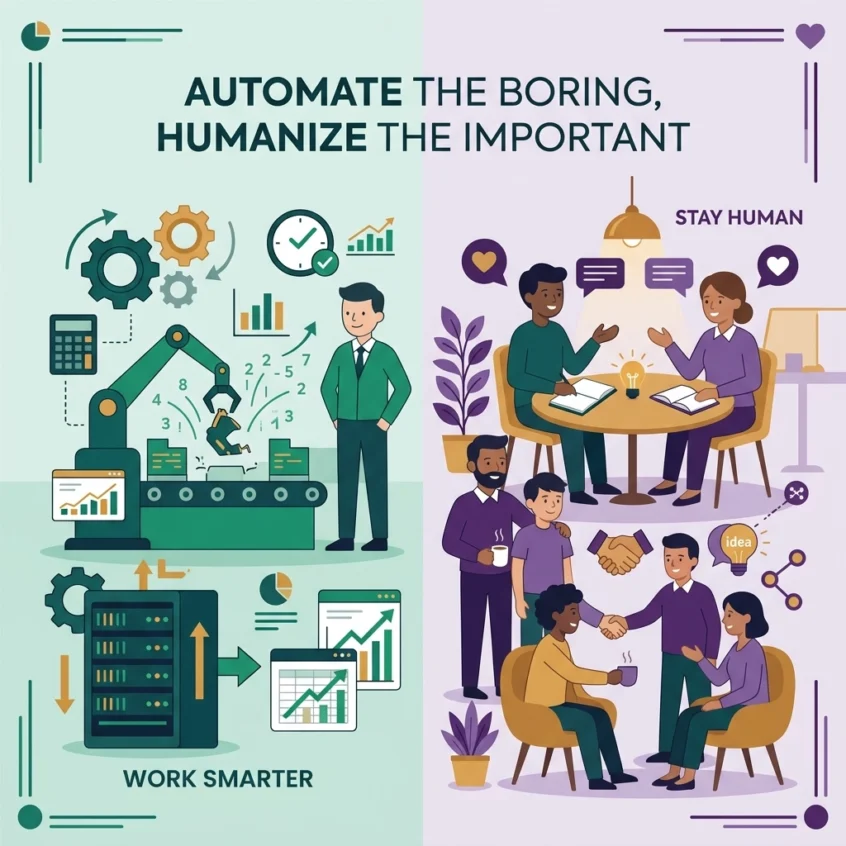
The framework is simple: Automate the Boring, Humanize the Important.
The Cognitive Tax of the Mundane
Every time you manually input data into a spreadsheet, copy-paste a meeting summary, or spend forty minutes triaging an inbox filled with "FYI" emails, you pay a cognitive tax. You are using high-level human hardware to perform low-level machine tasks.
In Canada, the productivity gap is widening. We often talk about "working harder" to catch up to our global peers, but harder isn't the answer. Smarter is. When we force ourselves to endure repetitive, tedious tasks, we exhaust the very mental reserves needed for the high-value, high-stakes human interactions that actually move the needle for our businesses.

Automate the Boring: The 2026 Standard
Automation is no longer about complex coding or expensive enterprise software. It’s about leveraging the "Boring AI" that Ethan Mollick and other industry leaders have championed. We’re talking about the mental drudgery that holds you back.
If a task meets any of the following criteria, it should be automated:
- High Frequency: You do it every day or every week.
- Low Variability: The steps are the same every time.
- Low Emotional Stakes: No one’s feelings are hurt if a machine processes the data.
Think about your current workflow. Are you still manually scheduling interviews? Are you manually sorting through performance review data to find trends? These are "boring" tasks. They are mentally dangerous because they lull you into a state of autopilot, where mistakes happen and creativity dies.
In the Canadian context, where labour shortages continue to plague sectors from healthcare to tech, we cannot afford to waste human potential on tasks that a simple Python script or a tuned LLM can handle in seconds. We need our people focused on problem-solving, not data entry.
Humanize the Important: Where You Actually Matter
Once you’ve cleared the sludge, what’s left? The "Important."
The "Important" is work that requires empathy, ethical judgement, complex strategy, and authentic connection. These are the areas where AI fails: and where you, as a leader or professional, must double down.
When we talk about "Humanizing the Important," we mean reclaiming the spaces where your presence is a value-add, not a bottleneck.
- Mentorship and Coaching: You can use AI to track progress, but you cannot use it to inspire a struggling employee.
- Conflict Resolution: Navigating the subtle power dynamics of a Canadian boardroom requires a level of emotional intelligence that code cannot replicate.
- High-Stakes Decision Making: AI can provide the data, but the accountability: the "fearless leadership": rests with the human.
Humanizing the work means ensuring your communication doesn't sound like a template. It means using your first-person perspective, your unique professional history, and your genuine expertise to lead. If you use AI to write your most important strategic memos without editing them for "soul," you aren't working smarter; you're just being lazy.

The Intuitive Workplace Audit
How do you actually start? You need a "Work Smarter" audit. Take a look at your calendar for the last fourteen days. Highlight every task that made you feel like a robot.
If you were extracting data from one programme to put it into another: automate it. If you were generating a report that no one actually reads but is "required by policy": question its existence, then automate the collection.
The goal is to move towards a workplace where the "boring" is invisible. It happens in the background, handled by systems designed to serve the human. This frees you up to engage in the "Stay Human" pillar of our philosophy: managing burnout, fostering genuine professional development, and leading with a clear head.
The Leadership Shift: From Manager to Architect
For HR leaders and executives, this shift is even more critical. Your role is shifting from managing people’s time to architecting their focus.
When you allow your team to be bogged down by inefficient processes, you are effectively telling them that their unique human skills aren't valued. A leader who prioritises automation is a leader who respects their team's mental health. By removing the repetitive "mental noise," you reduce the risk of burnout. Burnout in the Canadian workplace often stems not just from the volume of work, but from the perceived meaninglessness of the tasks.
I break this down further inside The Intuitive Workplace Pro. We look at the specific tech stacks that work for Canadian businesses and how to transition a traditional culture into an AI-augmented powerhouse.
Practical Steps for Monday Morning
Don't wait for a company-wide digital transformation. Start at your own desk.
- Identify one "Boring" task: Something you do at least once a week that requires zero creativity.
- Find the Tool: Whether it’s an AI agent, a Zapier integration, or a simple macro, find a way to delegate it to the machine.
- Invest the Saved Time: Do not just add more tasks to your plate. Take that hour you saved and invest it in a "Human" task. Walk the floor. Have a one-on-one. Think about your long-term strategy.
- Audit the Output: If you use AI to assist with something "Important" (like a project proposal), spend the time to humanize the language. Ensure it reflects your voice and your brand’s tone.

Why This Matters Now
The Canadian economy is at a crossroads. We have some of the most educated talent in the world, yet we struggle with innovation adoption. By embracing the "Automate the Boring" mindset, we stop treating technology as a threat and start treating it as a liberator.
The professionals who thrive in the next five years won't be the ones who work the longest hours. They will be the ones who have mastered the art of delegation: not just to other people, but to the digital systems at their fingertips.
Lead Fearlessly by making the tough call to cut the redundant processes.
Stay Human by protecting your mental energy for the things that matter.
Work Smarter by letting the machines handle the rest.
If you’re still doing your own scheduling, manual data scraping, or routine reporting, you’re not just behind the curve: you’re ignoring your own potential. It’s time to stop acting like a processor and start acting like a professional.
I break this down further inside The Intuitive Workplace Pro.

Summary of the Framework
| Task Category | Action | Desired Outcome |
|---|---|---|
| The Boring | Automate / Delegate to AI | Efficiency, speed, mental space. |
| The Important | Humanize / Deep Work | Trust, impact, leadership, innovation. |
| The Redundant | Eliminate | Resource recovery, morale boost. |
Stop apologising for using technology to make your life easier. If a machine can do it, it probably should. Your value isn't in your ability to follow a routine; it's in your ability to break it when the situation calls for a human touch.
Vocational Quest is here to ensure that as the world becomes more digital, your workplace becomes more intuitive. Let’s get to work: the human kind.