
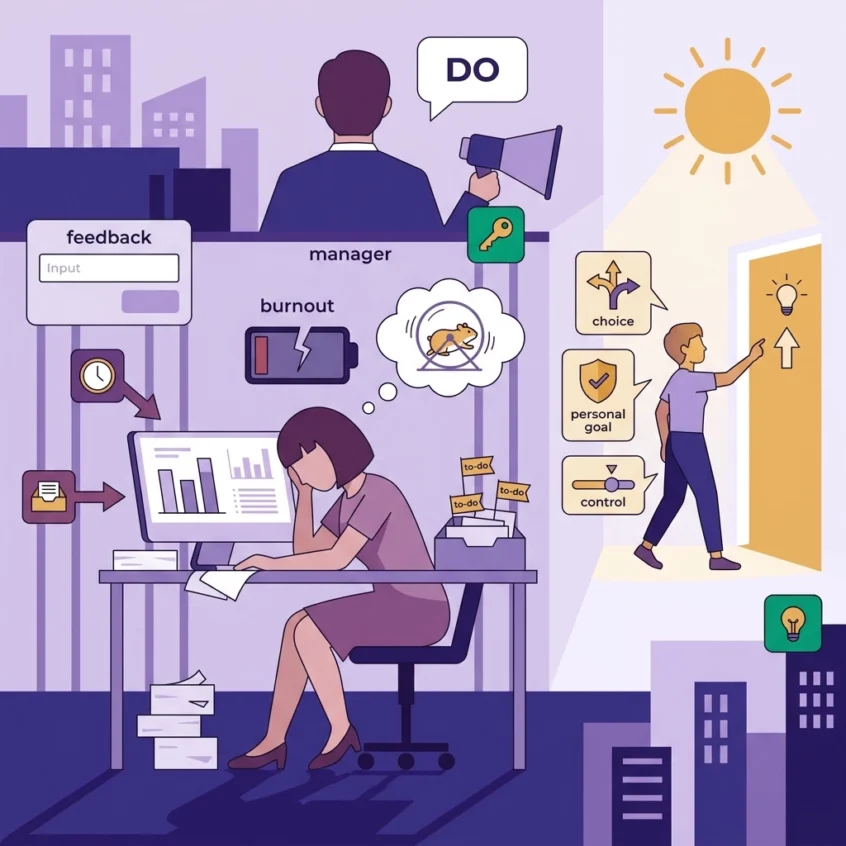
You aren’t tired because you’re working too hard. You’re tired because you’ve lost the steering wheel.
For years, the corporate wellness industry has sold us a lie. They told us that burnout is a simple math equation: Too much work + too little sleep = exhaustion. Their solution? Take a Friday off. Go to a yoga retreat. Eat a kale salad. Download a meditation app that pings you while you’re in the middle of a high-stakes meeting.
It’s nonsense. If workload were the primary driver of burnout, every high-performing CEO, entrepreneur, and emergency room surgeon would be permanently incapacitated. Yet, many of them thrive on 60-hour weeks. Why? Because they have agency.
Burnout isn’t a volume problem; it’s a power problem. It is the psychological erosion that occurs when a human being is stripped of their ability to make meaningful choices about their own labour. At The Intuitive Workplace, we believe that staying human in a digital world requires us to stop counting hours and start measuring autonomy.
The Canadian Crisis: Beyond the "Busy" Badge
In Canada, we are currently facing a mental health epidemic that the traditional HR handbook isn't equipped to handle. According to Mental Health Research Canada (MHRC), nearly 35% of Canadian workers report feeling burnt out. Even more telling, a staggering number of employees cite "lack of control" and "high job strain" as the primary drivers of their distress.
When the Mental Health Commission of Canada (MHCC) developed the National Standard for Psychological Health and Safety in the Workplace, they identified "Influence and Participation" as a key psychosocial factor. This isn't just HR fluff. It is a recognition that when Canadians feel like cogs in a machine, unable to influence how their work is done, their brains begin to shut down.

What Is Agency, Anyway?
Agency is the capacity to act independently and make free choices. In a workplace context, it’s the difference between being an architect and being a bricklayer who isn't allowed to see the blueprints.
Psychologists Edward Deci and Richard Ryan explored this through Self-Determination Theory. They argued that humans have three innate needs: autonomy, competence, and relatedness. Autonomy (agency) is the bedrock. Without it, competence feels like a chore and relatedness feels like a trap.
When you have agency, you can:
- Prioritize your output: You decide which fire to put out first.
- Define your process: You choose the tools and methods that fit your cognitive style.
- Negotiate boundaries: You have the authority to say "no" or "not right now" without fear of retribution.
When agency is removed, you enter a state of "learned helplessness." This is the psychological precursor to burnout. You stop trying to innovate because you know your ideas will be ignored. You stop trying to manage your time because your calendar is owned by people who don't understand your job. You are effectively handcuffed to a desk, forced to watch your most valuable asset: your attention: be set on fire by someone else's poor planning.
The Toxic "Reactive Trap"
Lack of agency forces you into a permanent state of reactivity. You become a professional firefighter in a building made of oily rags.
In most modern Canadian workplaces, the day doesn't start with a plan; it starts with an onslaught. Slack notifications, urgent emails, and "quick syncs" dominate the morning. By noon, you haven't touched your actual work. You are trapped in what productivity experts call "Quadrant 1" tasks: urgent and important (or at least, urgent to someone else).

Because you lack the agency to decline these interruptions, your brain stays in a high-cortisol "fight or flight" mode. This isn't just stressful; it’s biologically expensive. Your prefrontal cortex: the part of the brain responsible for high-level strategy and emotional regulation: begins to fatigue. This is why, after a day of doing "nothing" but answering emails, you feel more exhausted than if you had spent eight hours writing a complex report.
The Micromanagement Factory
Micromanagement is the ultimate agency-killer. It is a leadership failure disguised as "quality control."
When a manager dictates not just the what, but the how, the when, and the who, they are essentially telling the employee: "I don't trust your judgment." This lack of trust is a psychological tax. In Canada, where our workplace culture often prides itself on egalitarianism and collaboration, the "command and control" style of leadership feels particularly abrasive.
A study from the University of Toronto’s Rotman School of Management has previously highlighted that job control is a significant predictor of health. Workers with high-demand jobs but low control have a significantly higher risk of cardiovascular disease and mental health decline compared to those with high-demand jobs and high control.
If you are a leader, you need to understand this: Every time you "check in" unnecessarily, every time you override a subordinate’s decision without explanation, and every time you demand a meeting for something that could have been an asynchronous update, you are contributing to the burnout of your team. You aren't "staying on top of things"; you are draining the battery of your most important resources.
The Performance Wellness Insult
Let’s talk about the "Pizza Party" phenomenon.
When a team is drowning because they lack the agency to fix a broken process, and the organization responds by bringing in a "Wellness Coach" to teach them box-breathing, it is an insult. It’s performative wellness. It places the burden of "fixing" burnout on the individual rather than the system.
Real wellness isn't found in a mindfulness app. It’s found in the power to leave a meeting that has no agenda. It’s found in the ability to work from 7 AM to 3 PM because that’s when your brain is sharpest, without having to ask for permission. It’s found in having a clear "Definition of Done" so you can actually switch off your brain at the end of the day.

How to Reclaim Agency (And Save Your Sanity)
If you’re feeling the flames of burnout, don't reach for a vacation brochure first. Reach for your boundaries. Reclaiming agency is a process of radical honesty and strategic friction.
1. Audit Your Autonomy
Take a look at your last five workdays. For every task, ask: "Did I choose to do this, or was it imposed on me?" If 90% of your day is imposed, you are in the danger zone. Identify one area where you can claw back control. Perhaps it’s a specific hour of "Deep Work" where your notifications are off: no exceptions.
2. Move From Permission to Information
Stop asking, "Is it okay if I do X?" Start saying, "I am doing X to achieve Y. Let me know if there are any blockers." This subtle shift in language signals agency. It moves you from a child-parent dynamic with your supervisor to a peer-to-peer professional relationship.
3. Kill the "Always-On" Expectation
Agency requires the ability to disconnect. In Canada, we’ve seen movements toward "Right to Disconnect" legislation, similar to laws in Ontario (the Working for Workers Act). Use these frameworks. Set clear "out of office" parameters. If you don't own your time off, you don't own your time on.

4. Demand Clarity
Ambiguity is the enemy of agency. If you don't know what success looks like, you can't make decisions to get there. Force your leadership to define outcomes, not activities. When the goal is clear, you can choose the path. That choice is where the healing begins.
The Bottom Line
Burnout is the cry of a human spirit that has been reduced to an algorithm. We are not designed to be passive recipients of tasks; we are designed to be agents of change.
If your workplace feels like a prison of reactivity, no amount of self-care will save you. You don't need a massage; you need a mandate. You need the authority to own your work, your time, and your headspace.
At The Intuitive Workplace, we believe that the most productive employees are the ones who feel the most human. And nothing is more human than the power to choose.
Stop managing your stress and start managing your agency.
I break this down further inside The Intuitive Workplace Pro. Join us to learn how to restructure your workflow and lead your team with a "human-first" framework that actually works.
For more insights on navigating the modern workplace without losing your soul, explore our latest resources at Vocational Quest.