
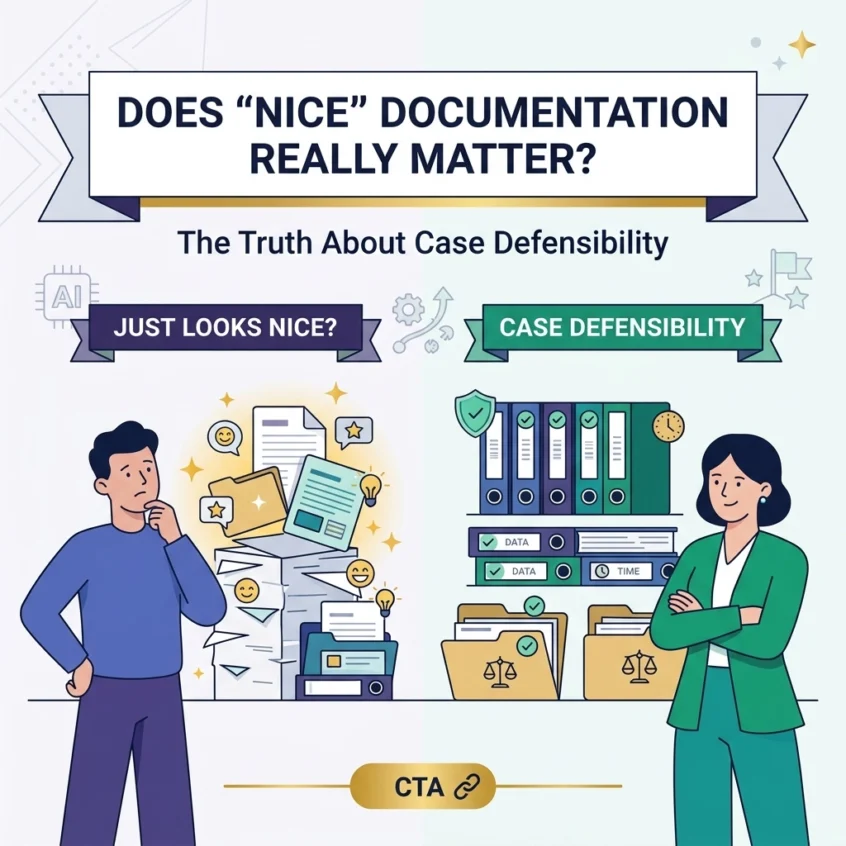
Let’s stop pretending. Most leaders view documentation as the "paperwork tax": a tedious, soul-sucking chore that stands between them and the "real work." You’ve probably heard it in your own office: "I don't have time to write a novel about every 1-on-1," or "They know what I meant, we have a good relationship."
But here is the cold, hard reality: In a legal or professional dispute, your "good relationship" doesn't exist. The only thing that exists is what is written on the page.
At Vocational Quest, we talk about The Intuitive Workplace. Being intuitive doesn't mean being "nice" or "soft." It means being sharp enough to recognize that clarity is the ultimate form of kindness: and the only form of protection that holds up in court. If you are leading a team in 2026, and your documentation is still vague, anecdotal, or missing, you aren't just being disorganized. You are being reckless.
The "Nice" Trap: Why Vague Documentation is Cowardice
We often use "nice" language in our documentation to avoid conflict. Instead of saying, "The employee failed to meet the quarterly KPI for the third consecutive month despite two formal warnings," we write, "We talked about some performance struggles and hope to see improvement soon."
This isn't leadership. This is conflict avoidance disguised as empathy.
When you use "nice" language, you create a "Defensibility Gap." This gap is where lawsuits live. If you eventually have to terminate that employee or deny a promotion, and your documentation from the last six months says "things are going okay," you have just handed their lawyer the winning argument. You’ve been inconsistent. You’ve been unclear. And in the eyes of a tribunal, you’ve been unfair.
Lead Fearlessly means having the courage to document the truth. Defensible documentation isn't about being mean; it’s about being accurate. It’s about creating a record that is so clear and objective that any third party: a judge, an HR director, or a union rep: could read it and reach the same conclusion you did.

The Canadian Landscape: High Stakes and Legal Reality
In Canada, the legal standard for documentation is high. Whether you are dealing with the Ontario Human Rights Commission (OHRC) or a provincial Employment Standards branch, the burden of proof often rests on the employer to show they acted reasonably and followed due process.
Consider these statistics:
- In a recent analysis of Canadian wrongful dismissal cases, a staggering number of employers lost not because they lacked a reason for dismissal, but because they lacked the contemporaneous documentation to prove the steps they took leading up to it.
- According to the Human Rights Tribunal of Ontario’s Annual Report, thousands of applications are processed annually, with many focusing on failure to accommodate or discrimination. Without a paper trail showing "standard of care" and a rigorous accommodation process, organizations are left defenseless.
- The "Coordination Tax" is real. Teams spend roughly 25% of their time just trying to figure out what happened in the past because notes are so poor.
If you are leading in Canada, you aren't just managing people; you are managing a legal record. If your documentation is "nice" but lacks substance, you are essentially gambling with your organization’s reputation and budget.
What Makes Documentation "Defensible"?
Defensibility is not about quantity; it’s about quality and "standard of care." A 10-page rambling email is often less defensible than a five-bullet-point objective summary. To lead fearlessly, your documentation must adhere to these five pillars:
1. Contemporaneousness
If you wrote the note three weeks after the event, it has significantly less evidentiary weight. In the eyes of a court, your memory is already tainted. Defensible leaders document in the moment: or at least within 24 hours.
2. Objectivity vs. Subjectivity
- Subjective (Weak): "John seemed angry and was being difficult during the meeting."
- Objective (Strong): "John raised his voice, interrupted the speaker three times, and stated, 'I am not doing this work.' This violated the Workplace Conduct Policy Section 4."
Do you see the difference? The first is an opinion. The second is a fact. You can’t defend an opinion; you can defend a fact.
3. The "Standard of Care"
In vocational and professional development contexts, you must show that you followed established guidelines. Whether it’s internal SOPs or external standards like NICE guidelines, you need to document why you made a specific decision. If you deviated from a standard, you must document the rationale. "Because I felt like it" is not a rationale.
4. Specificity of Consequences
Documentation must show that the individual was aware of the expectations and the consequences of failing to meet them. If your notes don't show that you gave the person a chance to improve, your "case" is built on sand.
5. Clarity of Next Steps
Every entry should end with what happens next. This closes the loop and prevents the "I didn't know" defense.

The Leadership Perspective: Documentation as Radical Clarity
We need to shift the narrative. Documentation isn't something you do to an employee; it’s something you do for the integrity of the team.
When you document clearly, you are providing radical clarity. You are telling the employee exactly where they stand. There is no guesswork. There is no anxiety about "what the boss really thinks." Even if the news is bad, the clarity is a form of respect.
Leading fearlessly requires you to own the narrative. If you don't document the performance issues or the workplace dynamics, you are letting the circumstances control you. By maintaining a rigorous, objective record, you are taking control of the leadership narrative. You are ensuring that your decisions are based on data, not drama.
The Role of AI in Defensible Documentation
As we move toward The Intuitive Workplace, AI is becoming a powerful ally: if used correctly. We can use AI to help us move from "vague and nice" to "sharp and defensible."
AI tools can take your raw, messy notes and help you structure them into objective formats, highlighting where you’ve used subjective language that might hurt you later. However, the leadership remains with you. You cannot outsource the "fearless" part. You must be the one to verify the facts and ensure the tone reflects the reality of the situation.
Self-correction is vital here: While AI can help you work smarter, the legal defensibility rests on your human oversight. A "hallucinated" fact in a disciplinary note is a fast track to a lawsuit.

Documentation as a Professional Development Tool
At Vocational Quest, we believe that professional development isn't just for the people you lead: it’s for you, the leader. Learning how to document for case defensibility is a high-level leadership skill. It forces you to be a better observer, a more precise communicator, and a fairer adjudicator of performance.
If you want to dive deeper into how to protect your team and your career through high-level documentation and leadership strategies, we cover these frameworks extensively in our leadership modules.
Check out our deep-dive training here:
The Intuitive Workplace: Leadership and Documentation Mastery
The Takeaway: Stop Being Nice, Start Being Clear
The truth about case defensibility is that "nice" documentation is a liability. It creates ambiguity, encourages litigation, and signals a lack of leadership courage.
If you want to Work Smarter and Lead Fearlessly, you must embrace the discipline of documentation. It is the only way to ensure your decisions are respected and your organization is protected.
Next time you go to write a note about a difficult situation, ask yourself: "If a judge read this two years from now, would they see a leader who was clear and fair, or a manager who was 'nice' and vague?"
Choose clarity. Every single time.

I break this down further inside The Intuitive Workplace Pro. Join us to learn how to bridge the gap between "being a good person" and "being a defensible leader."
Stay Human. Lead Fearlessly.