
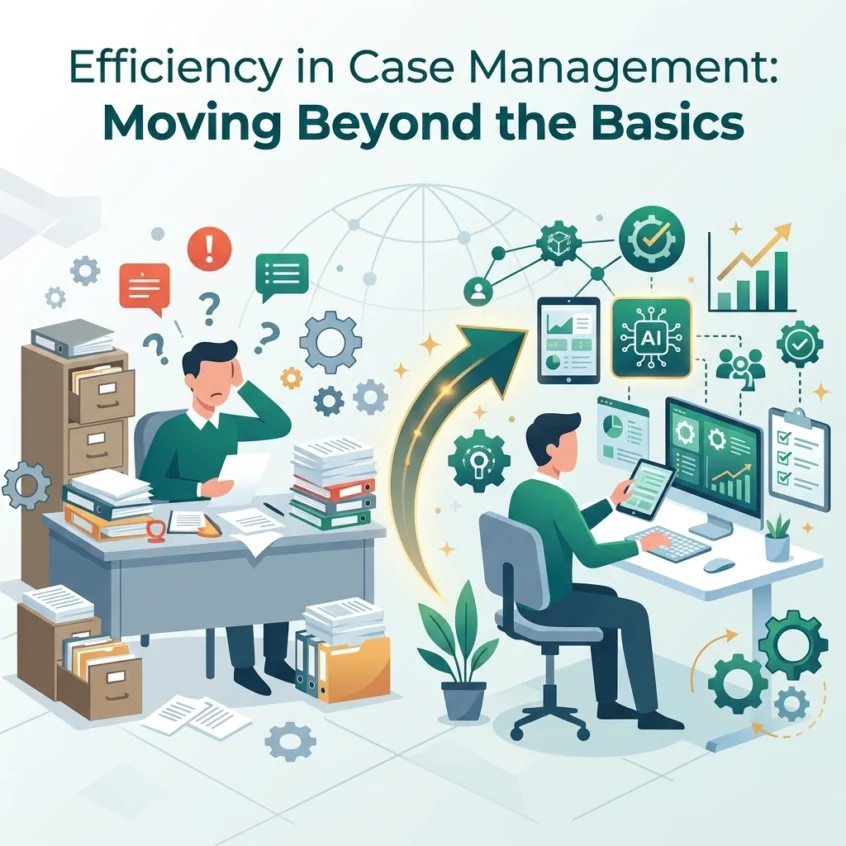
Let’s be honest: case management often feels like you’re trying to build a plane while it’s already 30,000 feet in the air. You have a pile of files, a ringing phone, and a client who needs a return-to-work plan yesterday. Most practitioners think "efficiency" means typing faster or skipping lunch. It isn’t.
Efficiency is about structured thinking. It’s about moving away from the "reactive fire-fighting" mode and into a "predictive strategy" mode. In the world of vocational rehabilitation and disability management, staying busy is easy. Staying effective is the real challenge.
To move beyond the basics, we need to stop treating case management as a series of administrative tasks and start treating it as a strategic discipline. This is how you work smarter, clear the backlog, and actually help humans get back to their lives without burning yourself out in the process.
The Efficiency Illusion: Why Your To-Do List is Lying to You
Many case managers equate a cleared inbox with a successful day. However, according to research on workplace productivity, "shallow work": like responding to non-urgent emails or re-formatting reports: takes up nearly 60% of a professional's time.
In Canada, the stakes are high. Mental health claims and disability leaves cost the Canadian economy over $50 billion annually (Mental Health Commission of Canada). When we are inefficient, we aren't just losing time; we are extending the duration of a client’s disability, which increases the likelihood that they will never return to the workforce.
To move beyond the basics, you have to kill the "busywork" culture. Efficiency starts with Structured Decision Models. Instead of staring at a blank screen wondering what to write in a rationale, you need a framework that dictates the flow of information.

Structured Interdisciplinary Collaboration
One of the biggest time-sinks in case management is the "information lag." You’re waiting for the doctor, the doctor is waiting for the employer, and the employer is waiting for you.
Moving beyond the basics means implementing a formal coordination protocol. This isn't just "checking in"; it’s about creating a shared documentation system that reduces redundant information gathering.
Key Strategies for Structured Coordination:
- Centralized Case Logs: Stop searching through email threads. Use a single source of truth for all stakeholder communications.
- Standardized Assessment Instruments: Use validated measurement tools that allow for objective data comparison over time. This makes your progress reports defensible and easy to read.
- Actionable Agendas: If you’re hosting a case conference, every minute must lead to a decision. Use an "If-Then" logic: If the medical clearance is received, then the modified work plan begins on Monday.
By using a structured model, you eliminate the "what now?" phase of case management. You move directly from data to decision.
Automate the Mundane, Humanize the Important
If you are still manually copying and pasting client demographics into five different forms, you are not working smarter. You are acting like a data-entry clerk.
Modern efficiency requires us to leverage technology to handle the heavy lifting of documentation. AI and automated workflow tools are no longer "futuristic": they are essential for survival in 2026.
Think about it: an AI tool can draft a case rationale based on your structured notes in seconds. This doesn't replace your clinical judgement; it provides a draft that you then refine with your expertise. This shifts your role from a "writer" to an "editor."
The Human Factor: When you automate the administrative bloat, you suddenly have 20% more time in your week. Do not fill that time with more files. Fill it with high-value human interaction. Use that time to build rapport with a client who is terrified of returning to work. Rapport isn’t a soft skill; it’s a clinical necessity that speeds up the recovery process.

The Power of Defensible Case Rationales
In the Canadian legal and insurance landscape, your notes are your shield. A basic case manager writes what happened. An efficient, advanced case manager writes why a decision was made, backed by data.
Moving beyond the basics means shifting to Evidence-Informed Practice. When you justify a vocational goal or a training program, you shouldn't rely on gut feelings. You should be referencing Labour Market Information (LMI) and functional capacity data.
How to Build a Defensible Rationale:
- State the Objective Data: What does the Functional Capacity Evaluation (FCE) actually say?
- Apply the Context: How does this data interact with the current Canadian labour market?
- Identify the Gap: What is the specific barrier to employment?
- Propose the Solution: Why is this specific intervention the most cost-effective and sustainable path forward?
This structured approach makes your reports "bulletproof" during audits or legal reviews. It saves you time in the long run because you won't be asked to rewrite or clarify your decisions six months down the line.
Managing the "Mental Load" of Case Management
We cannot talk about efficiency without talking about cognitive load. Case management is mentally taxing. You are carrying the weight of multiple people's futures.
In Canada, nearly 1 in 4 workers report high levels of daily stress. For those in helping professions, that number is even higher. To stay human, you must protect your focus.
Batching: Stop checking your email every five minutes. Batch your report writing into two-hour blocks of deep work.
Task Prioritization: Use the Eisenhower Matrix to distinguish between what is "urgent" (the phone is ringing) and what is "important" (the long-term strategy for a complex file).
If you want to dive deeper into these frameworks, I break this down further inside The Intuitive Workplace Pro.

The Data-Driven Review: Stop Guessing
How do you know if your case management style is actually working? If you aren't tracking your outcomes, you're just guessing.
Advanced practitioners track metrics such as:
- Average Duration of Claim: Is your structured approach actually getting people back to work faster?
- Resource Utilization: Are you spending the most money on the cases that actually need it?
- Success Rate of Vocational Interventions: Which training programs actually lead to long-term employment?
In Canada, provincial workers' compensation boards are increasingly moving toward data-driven models to manage rising costs. By adopting these habits now, you aren't just being more efficient: you are becoming more employable and authoritative in your field.
Summary: The Shift in Thinking
Efficiency in case management isn't about being a robot. It’s about using structured systems to handle the "robotic" parts of your job so you can be more human.
- Adopt a Framework: Use structured decision models for every file.
- Leverage Tech: Automate documentation to free up your brainpower.
- Be Defensible: Ground every rationale in objective data and LMI.
- Measure Results: Track your own efficiency to see what’s actually working.
When you move beyond the basics, you stop being a "paper pusher" and start being a vocational strategist. You lead the file; the file doesn't lead you. That is how you work smarter and lead fearlessly in a world that is only getting more complex.
Stay Human. Work Smarter.
Want to master these frameworks and get your time back? Explore our advanced training modules at Vocational Quest.