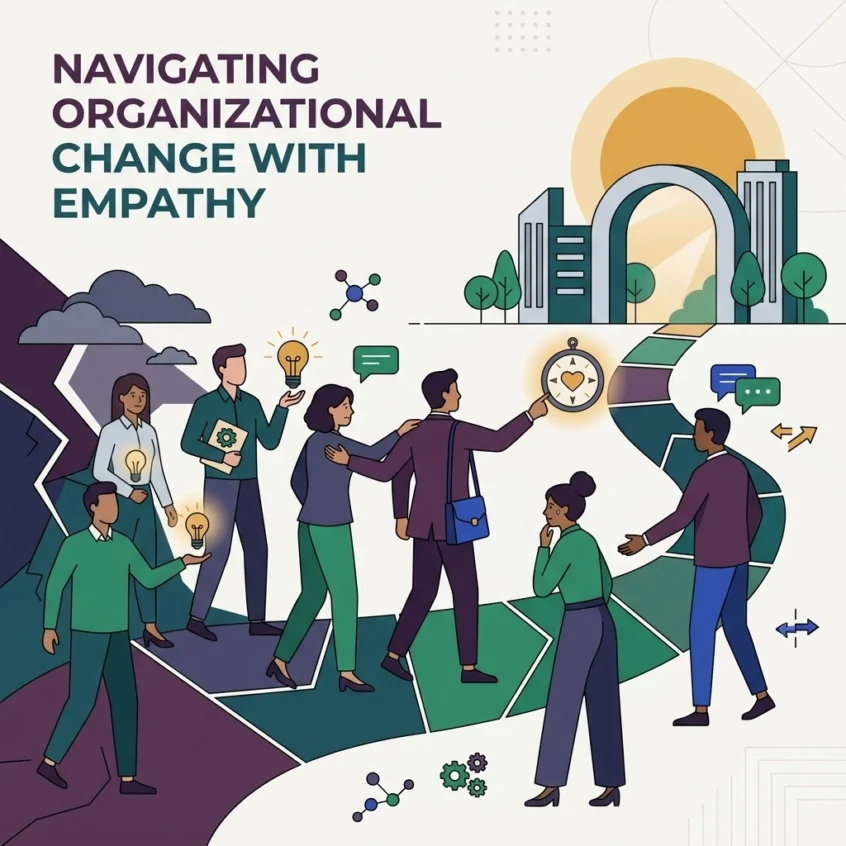
Change management is often treated like a software update: scheduled, pushed, and expected to run without bugs. But organizations aren’t made of code. They are made of people. When we ignore the human element, we don't just risk a "glitch": we risk a total system failure.
In Canada, the stakes are higher than ever. According to data from the Conference Board of Canada, workplace mental health issues cost the Canadian economy over $50 billion annually, with organizational instability cited as a primary stressor. Furthermore, a recent CPHR Canada report highlighted that nearly 60% of employees feel "change fatigue" when transitions are handled without clear, empathetic leadership.
If you want to lead fearlessly, you have to stop viewing empathy as a "soft skill" and start seeing it as a strategic imperative. At Vocational Quest, we believe the most successful transformations are those that put the human experience at the centre of the strategy.
The Intuitive Workplace by Dr. Drew Fockler: Work Smarter. Lead Fearlessly. Stay Human.
The Empathy Deficit in Canadian HR
Leading an organization through a merger, a pivot, or a digital transformation requires more than a Gantt chart. It requires an understanding of the psychological contract between the employer and the employee. When that contract is broken by "top-down" mandates that ignore personal impact, productivity plummets.
Inclusive leadership means recognizing that change affects different people in different ways. A neurodivergent employee might struggle with a new open-office plan; a staff member from a marginalized community might fear that "restructuring" is a coded term for bias.
To bridge this gap, we need a framework. Let’s look at John Kotter’s legendary 8-Step Change Model, but through a lens of radical empathy and inclusive leadership.

Step 1: Create Urgency (The Empathetic Spark)
Traditional urgency is built on fear: "If we don't change, we go under." Empathetic urgency is built on shared purpose.
The Shift: Instead of highlighting a "burning platform," highlight a "burning desire" for a better workplace. Acknowledge the current pain points of your staff. Use Canadian labour market stats to show why staying the same hurts the people inside the building just as much as the bottom line.
Step 2: Build the Guiding Coalition (Inclusive Leadership)
Don't just pick the C-suite. Your coalition must represent the diversity of your workforce.
The Shift: Ensure your guiding coalition includes voices from various departments, seniority levels, and backgrounds. This isn't just about optics; it’s about "Cultural Awareness in Vocational Practice." If your leadership team is a monolith, your change strategy will have blind spots that alienate half your workforce.
Step 3: Form a Strategic Vision (The Human North Star)
A vision isn't a 40-page slide deck. It’s a clear picture of a future where both the company and the employee win.
The Shift: Frame the vision around well-being and accessibility. "We are moving to a digital-first model to allow for greater flexibility and to better accommodate staff with diverse physical and cognitive needs." Boldly state the human benefit.
Step 4: Enlist a Volunteer Army (Communication & Engagement)
You can’t mandate buy-in. You have to earn it through transparent communication.
The Shift: Use "Empathy Audits." Instead of one-way town halls, host "Listening Circles." In Canada, where diverse perspectives are our strength, these sessions allow leaders to hear the real-world anxieties of their teams. Address the "Why" and the "How it affects ME" simultaneously.

Step 5: Enable Action by Removing Barriers (Accessibility & Support)
This is where most leaders fail. They give the order but leave the obstacles in place.
The Shift: Barriers are often systemic. This is where Disability Management Case Solutions become vital. If you are changing a workflow, have you considered how it impacts employees currently on accommodated work plans? Removing barriers means ensuring the new path is accessible to everyone, regardless of their physical or mental health status.
Step 6: Generate Short-Term Wins (Validation)
Change is exhausting. People need to see that their effort is paying off.
The Shift: Celebrate the behaviour, not just the KPI. If a team successfully adopts a more inclusive communication style during the transition, highlight it. In the Canadian context, recognizing contributions from diverse teams builds the social capital needed to finish the marathon.
Step 7: Sustain Acceleration (Resilience)
Once the first goal is hit, don't let off the gas, but don't redline your engines either.
The Shift: Monitor for burnout. Use your HR metrics to track not just output, but employee sentiment. If the "change" is causing a spike in short-term disability claims or mental health leaves, your acceleration is unsustainable. Real leadership is knowing when to pivot the pace to keep the team intact.
Step 8: Institute Change (Cultural Integration)
Make the new way "the way we do things around here."
The Shift: Anchor the change in your values. If the change was about being more efficient, show how that efficiency has freed up time for professional development or better work-life balance. Update your "Cultural Awareness" training to reflect the new organizational reality.

The ROI of Empathy in Leadership
Some might argue that this approach takes too long. They are wrong.
Leading without empathy results in "The Great Resignation" or, worse, "Quiet Quitting." A study by Workplace Strategies for Mental Health (an initiative by Canada Life) found that employees who feel supported by their managers during times of stress are 3.5 times more likely to remain productive.
When you lead with empathy, you aren't being "nice." You are being defensible. You are building a workplace that can withstand the next market shift because the people inside it trust the person at the helm.
Empathy Interviews: A Practical Tool
If you are currently in the middle of an organizational shift, I challenge you to conduct three "Empathy Interviews" this week.
- The Skeptic: Find the person most vocal against the change. Ask: "What is the one thing you’re afraid we’ll lose in this transition?"
- The Quiet One: Find the person who hasn't said a word. Ask: "What part of this plan feels most confusing to you?"
- The Front Line: Find the person most affected by the daily workflow change. Ask: "What is the biggest barrier I can remove for you today?"
Stay Human. Lead Fearlessly.
The future of work in Canada isn't just about AI and automation; it’s about the human ability to navigate those shifts together. At Vocational Quest, we provide the tools to help you master these dynamics. Whether it’s improving your Cultural Awareness in Vocational Practice or diving deep into Disability Management Case Solutions, our goal is to make you a more intuitive, effective leader.
I break this down further inside The Intuitive Workplace Pro.
Organizational change is a test of character, not just a test of strategy. Lead with empathy, remove systemic barriers, and remember that your team is your greatest asset.
Work Smarter. Lead Fearlessly. Stay Human.