
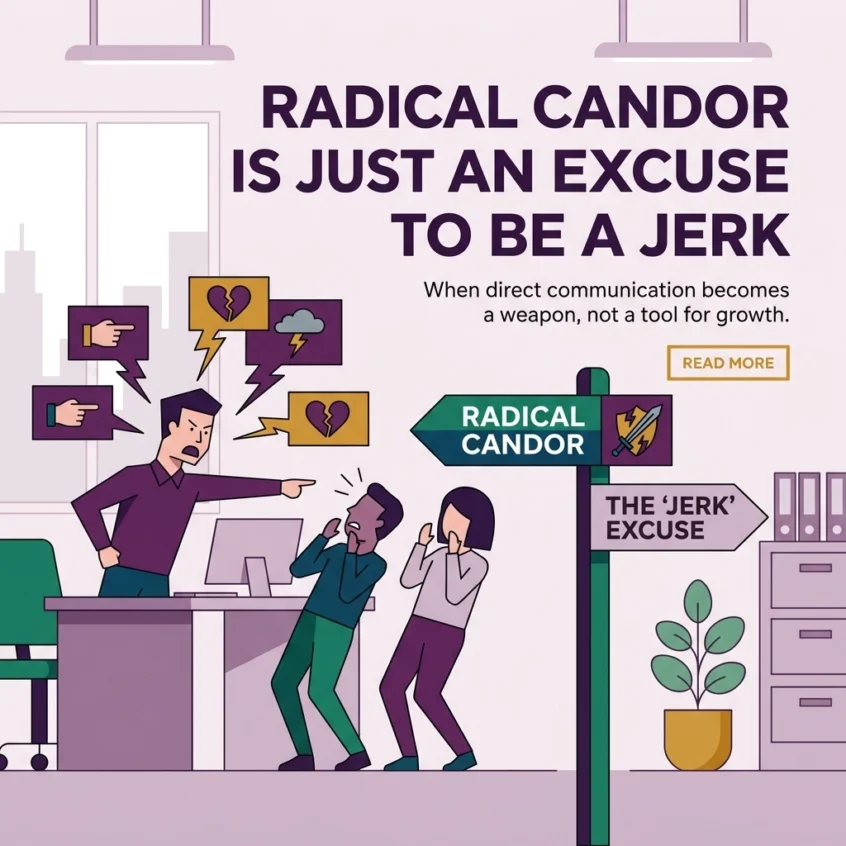
"I’m just being radically candid."
Whenever I hear a manager utter those words, I brace for impact. Usually, what follows isn't a breakthrough insight or a helpful piece of feedback. It’s a verbal grenade wrapped in the thin veneer of a trending management buzzword.
In the modern Canadian workplace, "Radical Candor" has become the favourite shield for the office bully. It’s the professional equivalent of saying, "No offence, but…" right before saying something deeply offensive. We’ve taken a framework designed to build trust and weaponised it to justify bad behaviour, zero empathy, and a complete lack of emotional intelligence.
If your version of candour leaves people feeling belittled, demotivated, or personally attacked, you aren’t leading fearlessly. You’re just being a jerk.
The Misunderstood Quadrant
The concept of Radical Candor, popularized by Kim Scott, is built on two axes: Caring Personally and Challenging Directly.
The sweet spot, Radical Candor, happens when you do both. But most "straight shooters" in leadership positions completely ignore the vertical axis of caring. They live exclusively in the "Obnoxious Aggression" quadrant. They think that by being blunt, they are being efficient. They think that by "telling it like it is," they are fostering a high-performance culture.
They are wrong.
When you challenge someone directly without caring personally, you aren't helping them improve. You are engaging in a power play. You are asserting dominance. In a country where the National Standard of Canada for Psychological Health and Safety in the Workplace sets clear expectations for how employees should be treated, this "blunt-force" leadership style isn't just outdated, it’s a liability.
According to Mental Health Research Canada, workplace stress and poor management are leading drivers of the "Great Resignation" or "Quiet Quitting" trends we see across the provinces. When leaders use Radical Candor as an excuse to ignore the psychological safety of their team, they aren't driving results; they are driving talent out the door.

The Laziness of Bluntness
Let’s call it what it is: being blunt is easy. It’s lazy.
It takes zero effort to point out a mistake and walk away. It takes significant effort, emotional labour, and intellectual rigour to deliver feedback that actually lands. True leadership requires you to understand the person on the receiving end.
- What is their communication style?
- What are their current stressors?
- How can I frame this critique so they actually hear it instead of retreating into a defensive shell?
If you claim you "don't have time" for that kind of nuance, you don't have time to be a leader. You are merely a supervisor of tasks, and a poor one at that. Radical Candor was never meant to be a license to skip the human element of management. It was meant to be the bridge that connects high standards with high support.
Canadian Workplace Standards and the Cost of Toxicity
In Canada, the legal and social landscape of the workplace is shifting. We are seeing a heightened focus on "behaviours that undermine a healthy work environment."
A report by the Mental Health Commission of Canada suggests that mental health issues cost the Canadian economy more than $50 billion annually, with a significant portion attributed to workplace environment. When a leader creates a culture of "Radical Candor" that is actually a culture of "Radical Cruelty," they are directly contributing to these figures.
Toxicity doesn't stay contained. It spreads. When a leader is a jerk under the guise of being "candid," the team learns that empathy is a weakness. They stop collaborating. They stop taking risks. They stop being honest with the leader because they know the "candour" only flows one way.
If you are curious about how to actually balance these dynamics without the toxicity, I go deeper into this in our leadership tracks. You can find more structured approaches here: Professional Development for Leaders.

Accountability vs. Aggression
There is a massive difference between holding someone accountable and being aggressive.
- Accountability: "The data in this report is incorrect, which led to a budget error. We need to figure out where the process broke down so this doesn't happen again. How can I support you in fixing the workflow?"
- Aggressive "Candour": "This report is a disaster. If you can't handle basic data entry, maybe this role isn't for you. I'm just being radically candid."
The first approach focuses on the work and the solution. The second approach focuses on the person’s character and their security. One builds a better employee; the other builds a resentful one.
Lead Fearlessly doesn’t mean leading without a filter. It means having the courage to have the hard conversations while maintaining the integrity of the relationship. It means being brave enough to look in the mirror and ask, "Am I saying this to help them, or am I saying this to feel superior?"
Practising Real Candour
If you want to move away from being the "candour jerk" and toward being an actual leader, you need to practise three things:
1. The Intent Check
Before you deliver feedback, ask yourself: What is my goal? If your goal is to vent your frustration or "put someone in their place," keep your mouth shut. If your goal is to help that person grow or protect the project, proceed, but lead with that intent.
2. The Relationship Deposit
You cannot challenge someone directly if you haven't put in the work to care personally. You haven't earned the right to be "radically candid" with someone you haven't bothered to get to know. Trust is the currency of feedback. If your account is empty, your feedback will be rejected.
3. The Follow-Through
Candour is a dialogue, not a monologue. If you drop a "truth bomb" and walk away, you aren't leading. You are abandoning your team in a mess of your own making. Real candour requires staying in the room, listening to the response, and co-creating a path forward.

Stop Hiding Behind Buzzwords
The era of the "brilliant jerk" is over. In a globalized, highly competitive market, the teams that win are the ones that can communicate effectively without destroying each other's morale.
Radical Candor is a powerful tool when used correctly. It can clear bottlenecks, resolve long-standing conflicts, and propel a team to excellence. But it requires a level of maturity and self-awareness that many leaders simply haven't developed yet.
Don't use Kim Scott’s work as a get-out-of-jail-free card for your lack of tact. Don't mistake your inability to regulate your emotions for "transparency." And definitely don't think that being the loudest, bluntest person in the room makes you the most effective.
Lead fearlessly, yes. But stay human while you do it.
The workplace doesn't need more jerks with better vocabularies. It needs leaders who are brave enough to be kind and strong enough to be clear.
I break this down further inside The Intuitive Workplace Pro. If you’re ready to stop the performative management and start leading with actual impact, join us.
Work Smarter. Lead Fearlessly. Stay Human.