
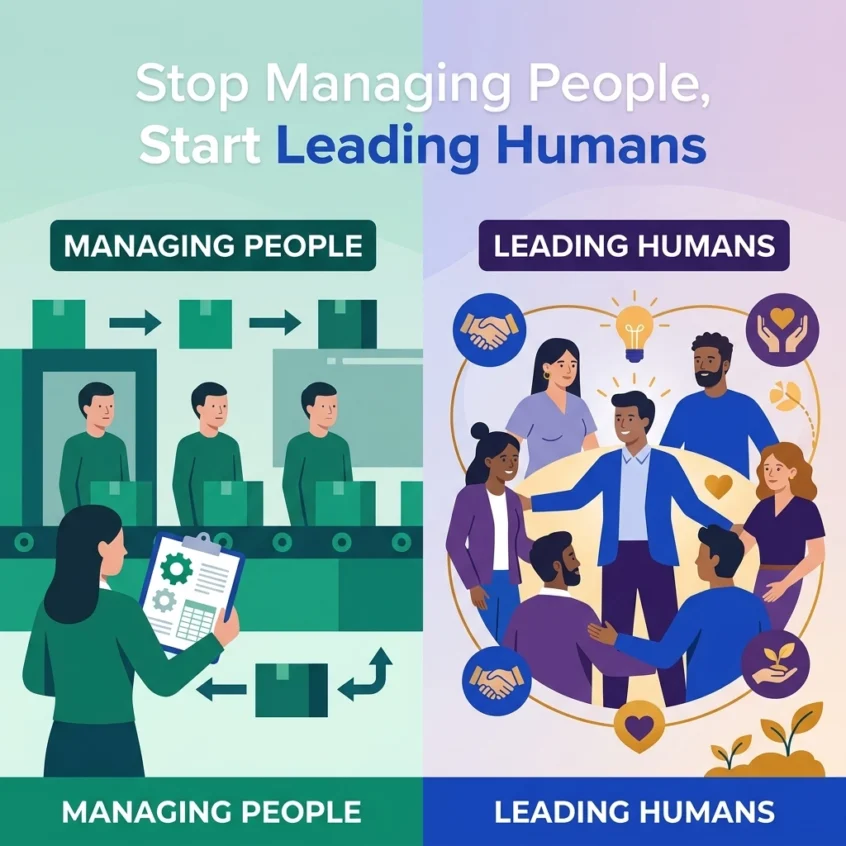
Most managers treat their teams like a fleet of aging sedans: keep the oil changed, hit the mileage targets, and pray nothing explodes before the quarterly review. This is the "resource" mindset: the idea that if you just pull the right levers and input the right amount of pressure, you get a predictable output.
It’s a lie. And in the modern Canadian workplace, it’s a dangerous one.
We have spent decades perfecting the art of managing resources. We’ve optimized supply chains, automated workflows, and digitized our entire existence. But in our rush to maximize efficiency, we forgot one fundamental truth: Humans are not resources. They are complex, emotional, and often unpredictable biological entities.
If you are still "managing" people by watching their Slack status icons or obsessing over minute-by-minute KPIs, you aren’t leading. You’re babysitting. And frankly, your best talent is already looking for the exit.
The Spreadsheet Delusion
Management is about maintenance. It’s about ensuring that the status quo is preserved and that the gears of the machine continue to grind at a steady pace. Leadership, however, is about evolution.
The "Spreadsheet Delusion" occurs when a manager believes that a person’s value can be fully captured in a cell on an Excel doc. We see this across Canada, from the tech hubs in Toronto to the industrial centres in Edmonton. We track hours worked, tickets closed, and emails sent. But these metrics don't measure impact; they measure activity.
According to recent data from Mental Health Research Canada, nearly 35% of Canadian workers report that their workplace is a primary source of mental health struggle. Why? Because being managed like a cog is soul-crushing. When you prioritize the KPI over the human behind it, you don't get high performance. You get burnout. You get "quiet quitting." You get a workforce that does exactly what is required to not get fired, and not a single ounce more.

Lead Fearlessly: The Human-Centric Shift
To lead fearlessly, you have to embrace the messiness of the human experience. You have to stop looking for "compliance" and start looking for "commitment." Compliance is what you get when people are afraid of the consequences. Commitment is what you get when people believe in the mission and feel seen by their leader.
Here is how we transition from rigid management to human-centric leadership.
1. Kill the Micromanagement Reflex
If you hired someone, it was presumably because they were capable of doing the job. So why are you hovering? Micromanagement is a manifestation of your own anxiety, not a reflection of their incompetence.
Leading humans means setting the destination and letting them choose the route. This is "Outcome-Based Leadership." If the work is high-quality and delivered on time, does it really matter if they took a two-hour walk at lunch to clear their head? In an era where 60% of Canadian employees value flexibility as much as salary, controlling the how is the fastest way to lose your top performers.
2. Radical Empathy is Not "Being Nice"
There is a persistent myth that human-centric leadership is "soft." Let’s kill that right now.
Empathy is a diagnostic tool. It allows you to understand the underlying barriers to performance. If a high performer suddenly drops off, a manager asks, "Why aren't you hitting your numbers?" A leader asks, "What has changed in your environment that is preventing you from succeeding?"
Leading humans requires you to have the backbone to have difficult conversations. It means being honest about performance while being supportive of the person. You are not their friend; you are their coach. Your job is to remove the obstacles: whether those are technical, systemic, or emotional.
3. The Listening Audit
Most managers listen with the intent to reply. They wait for a gap in the conversation so they can insert their "expert" opinion.
Start conducting a listening audit. In your next one-on-one, track how much of the time you are speaking versus how much they are speaking. If you are talking more than 20% of the time, you aren't leading: you’re lecturing.
Leading humans involves asking "What do you need from me?" and actually being prepared to act on the answer. This builds a culture of psychological safety, which is the single greatest predictor of team success.

The Canadian Context: Why Now?
The Canadian labour market is undergoing a seismic shift. With an aging population and a tightening talent pool, the power has shifted from the employer to the employee. In a 2024 report by the Conference Board of Canada, it was noted that retention is now the number one challenge for Canadian firms.
You cannot retain humans through management tactics alone. You cannot "process" someone into staying at a job they hate. People stay where they are valued, challenged, and respected.
When you focus on individual growth as a KPI, something interesting happens: the business KPIs tend to take care of themselves. When an employee feels that their personal development is a priority for the company, they repay that investment with innovation and loyalty.
Accountability vs. Control
One of the biggest fears managers have when moving toward a human-centric model is a loss of accountability. They think, "If I’m not breathing down their necks, how will I know they’re working?"
This stems from a misunderstanding of what accountability actually is. Control is external; it’s something you do to someone. Accountability is internal; it’s something someone takes for themselves.
Leadership is about fostering internal accountability. This is achieved through:
- Extreme Clarity: Does the person know exactly what success looks like?
- Ownership: Do they have the authority to make decisions?
- Feedback Loops: Are they getting real-time data on their performance, or are they waiting for a year-end review that feels like a post-mortem?

Stop Measuring "Time at Desk"
In the "Stay Human" pillar of our philosophy, we recognize that the 9-to-5, five-days-a-week model is a relic of the industrial revolution. It was designed for factory workers, not knowledge workers.
Humans have energy cycles. We have family emergencies. We have days where our brains simply refuse to cooperate. A manager sees a slow Tuesday as a problem to be corrected. A leader sees it as a natural fluctuation in human output.
By allowing for "human-shaped work," you build a resilient team. When you give people the space to be human during the slow times, they will move mountains for you when the pressure is on. This isn't just "being a good person": it's a defensible business strategy that reduces turnover costs and increases output quality.
The Intuitive Workplace Approach
At Vocational Quest, we don't just teach management; we facilitate leadership transformations. We believe that the future of work belongs to those who can bridge the gap between technical excellence and emotional intelligence.
If you are tired of the constant churn, the "quiet quitting," and the mid-level management burnout, it’s time to change your framework. Transitioning from a manager to a leader isn't a one-time event; it’s a daily practice of choosing humans over habits.
I break this down further inside The Intuitive Workplace Pro.
The Takeaway
Stop looking at your team as a collection of roles and start looking at them as a collection of individuals with distinct motivations, fears, and talents.
Management is about things. Leadership is about people.
If you want to build a team that is capable of navigating the complexities of the 2026 economy, you have to stop managing. You have to start leading. You have to stay human.
The shift isn't easy. It requires you to let go of the "command and control" ego that feels so safe. It requires you to be vulnerable, to listen more than you speak, and to prioritize relationships over reports. But the reward: a high-performing, loyal, and engaged team; is the only way to lead fearlessly in the modern world.
Work smarter. Lead fearlessly. Stay human.
