
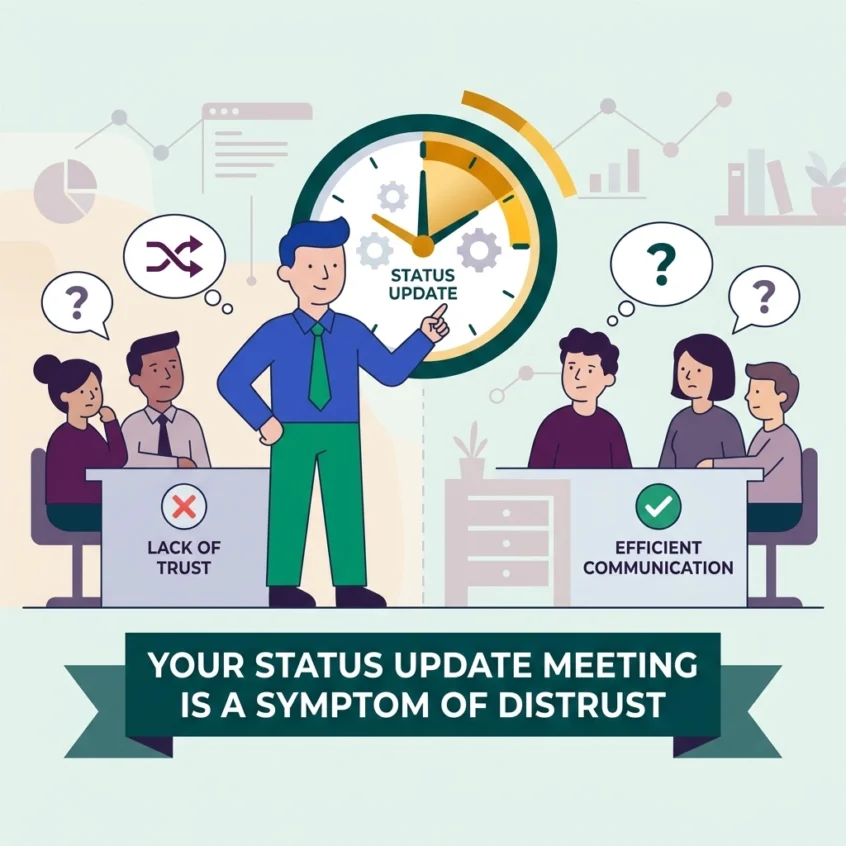
Let’s stop pretending that the "Monday Morning Sync" is about collaboration. It’s not. It’s a performance. It’s a high-stakes theatre production where employees spend Sunday night polishing bullet points to prove they aren't lazy.
If you are a manager who insists on a weekly status update meeting, I have a hard truth for you: Your meeting is a glaring symptom of a low-trust culture. You don't need a meeting to know what's happening; you need a meeting because you don't trust your team to do the work without you watching them talk about it.
In the modern workplace, the status update meeting is a relic of the industrial age. It’s the digital equivalent of a factory foreman walking the floor to make sure every station is occupied. But we aren't moving widgets on a belt; we are doing deep, cognitive labour. And every time you pull your team into a "quick sync," you are tax-evading their productivity.
The Visibility Gap: Why We Cling to Calendars
Most leaders don’t wake up wanting to be micromanagers. They become micromanagers because of the "Visibility Gap." When you can't see the work being done, you feel a loss of control. Instead of building a system that makes work visible, you default to the easiest, laziest tool in your arsenal: the calendar invite.
When a manager lacks confidence in the progress of a project, they lean on manual check-ins to fill the void. This replaces actual trust with a cycle of "just circling back." It creates a culture where visibility is earned through repetition rather than built into the workflow itself.
In Canada, this is becoming a critical issue as we navigate the permanent shift to hybrid and remote work. According to Statistics Canada, as of late 2023, approximately 20% of the Canadian workforce continues to work primarily from home. In these environments, the lack of physical presence often triggers "productivity paranoia" in leaders. They over-compensate with meetings, failing to realize that every minute spent reporting on work is a minute stolen from actually doing it.

The High Cost of "Checking In"
Every status update meeting has a hidden invoice. It isn't just the 30 minutes of the meeting itself; it’s the "Meeting Recovery Syndrome." Research suggests it takes an average of 23 minutes to get back into a state of deep focus after an interruption.
When you schedule a 10:00 AM status meeting, you aren't just taking 30 minutes. You are effectively killing the entire morning for your developers, writers, and designers. You are fracturing their cognitive flow.
In a low-trust environment, these meetings also become performative. Employees start "padding" their updates. They over-document trivial tasks to appear busy. They prioritize visible work over impactful work. This isn't just inefficient; it’s a mental health hazard. It breeds resentment and burnout. People want to be hired for their expertise, not their ability to narrate their To-Do list.
Surveillance is Not Management
Let’s be clear: If your status update meeting feels like a deposition, you are participating in surveillance, not leadership.
When you demand that a team member accounts for every hour of their day in a group setting, you are sending a clear signal: I don't believe you are working unless I am watching. This is the fastest way to decapitate morale. High-performers don't need to be monitored; they need to be empowered.
If you don't trust your employees to work autonomously, why did you hire them? If you can’t trust them to deliver results without a weekly interrogation, you either have a hiring problem or a character problem. Usually, it’s the latter. Managers who rely on meetings for "comfort" are often projecting their own insecurities or their inability to define clear Key Performance Indicators (KPIs).

The Asynchronous Alternative: Work Smarter
So, how do you fix it? You kill the meeting.
If the goal of your meeting is to "stay in the loop," that loop should be a dashboard, not a conversation. Work Smarter leaders recognize that status updates are data, and data should be consumed asynchronously.
Here is how you transition from a "Meeting-First" to an "Async-First" culture:
- Centralize the Truth: Use project management tools (Notion, Trello, Jira, Asana) where the status of every task is updated in real-time. If a manager wants to know where a project stands, they look at the board. They don't ask the person.
- The Friday Update: Have team members post a brief, written summary of their wins, blockers, and next steps in a dedicated Slack or Teams channel. This allows everyone to read and digest the information at their own pace without breaking their focus.
- Reserve Meetings for "Why," Not "What": Meetings should be reserved for brainstorming, complex problem-solving, or emotional connection. If the information can be sent in an email, send the email. If the information can be read on a dashboard, read the dashboard.
- Embrace Results-Oriented Work Environments (ROWE): Shift your focus from "hours in seat" or "words in meeting" to "outcomes achieved." If the work is done well and on time, the "how" and "when" shouldn't matter.
The Canadian Context: Leading Fearlessly
In the Canadian professional landscape, we often pride ourselves on a polite, collaborative culture. However, this politeness sometimes masks a fear of directness. We hold meetings to "get everyone on the same page" because we’re afraid of the friction that comes with individual accountability.
Leading fearlessly means being direct about expectations and then stepping back. It means realizing that a quiet Slack channel isn't a sign of laziness; it’s often a sign of a team that is deeply focused and organized.
By eliminating the status update meeting, you aren't losing touch; you are gaining respect. You are telling your team, "I value your time more than my own need for reassurance." That is how you build a culture of high-trust and high-performance.

Stop Measuring Presence, Start Measuring Impact
The shift to a truly productive workplace requires a fundamental change in how we define "management." A manager's job isn't to be the most informed person in the room regarding every micro-task. Their job is to remove blockers, provide resources, and set the vision.
If you spend your day in status meetings, you aren't leading. You are clerical support with a fancy title. You are an information router.
When you stop demanding status updates, you force yourself to become a better leader. You have to learn how to set clearer goals. You have to learn how to interpret data. You have to learn how to coach people rather than just checking their homework.
The Intuitive Workplace Shift
Trust is the currency of the modern economy. Organizations that hoard information and gatekeep visibility through meetings will eventually lose their best talent to companies that treat adults like adults.
If you’re feeling the itch to schedule a "quick sync" to see where things are at, pause. Ask yourself: "Do I really need to talk to them, or do I just need to see the progress?" If it’s the latter, go find the data yourself. Let your team work.
I break this down further inside The Intuitive Workplace Pro, where we dive deep into building asynchronous systems that actually work for human beings, not just for spreadsheets.
Check out our Professional Development programs here.
Stop the surveillance. Kill the meeting. Start trusting your people.
Work Smarter. Lead Fearlessly. Stay Human.